Anyone cross-shopping waterfront in this part of Wisconsin eventually asks the same question: why does a house on Lake Wisconsin in Prairie du Sac cost a fraction of a comparable house on Lake Mendota or Lake Monona in Madison, when both come with a pier, a view, and a boat ramp within walking distance? The easy answer is distance. Prairie du Sac sits about 25 miles northwest of the Capitol square. Mendota and Monona sit inside the city, ringed by neighborhoods like Maple Bluff and Shorewood Hills where recent listings have asked in the seven figures, commonly $1.6 million to $4.6 million on Mendota and $825,000 to $1.4 million on Monona.
Distance explains some of the gap. It does not explain why the two bodies of water are regulated so differently, or why a buyer moving from a Madison lake to a Sauk County one is walking into a completely different permitting relationship the moment they want to fix a pier.
The Lake Isn't a Lake. It's a License.
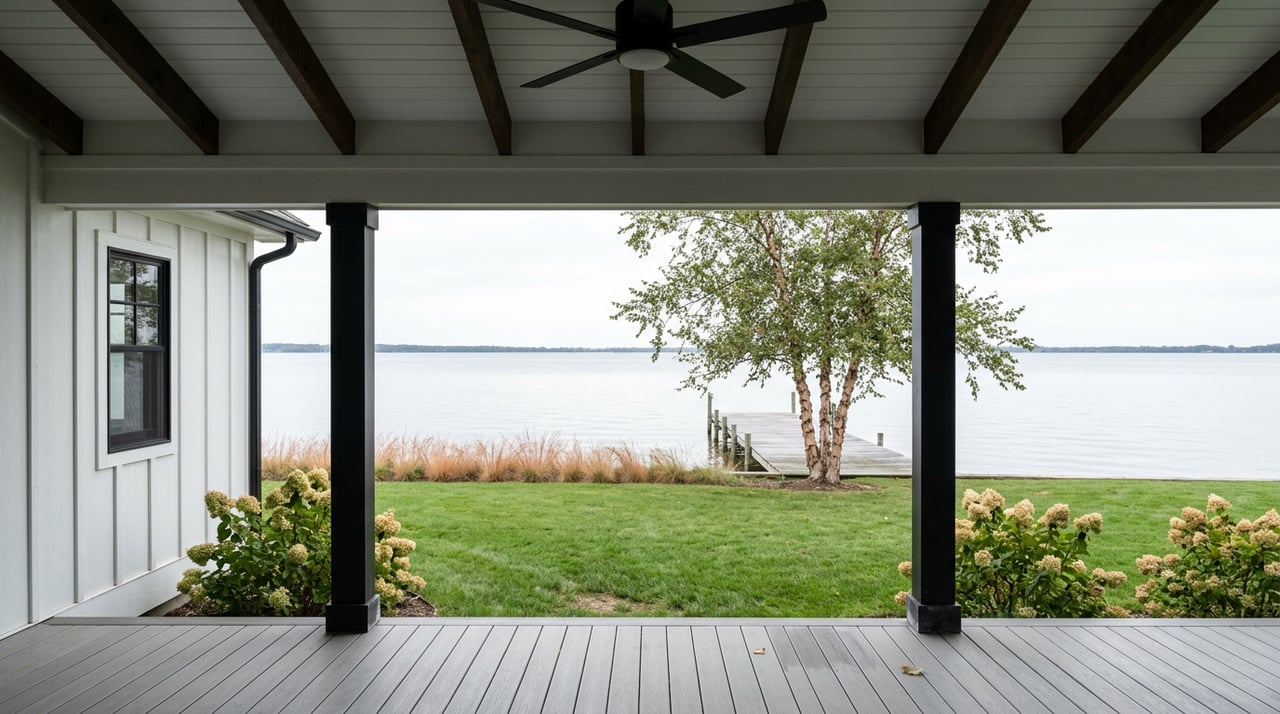
Lake Wisconsin doesn't occur naturally. It exists because Alliant Energy's Prairie du Sac Dam, completed in 1914 and operated by Alliant since 1970, backs up the Wisconsin River into a reservoir known locally as a flowage. Mendota and Monona are natural lakes shaped by glaciers. Lake Wisconsin is an engineered pool held behind a dam under a federal permit, which puts it in a different regulatory category entirely.
That permit is a Federal Energy Regulatory Commission license, and it's stricter than most buyers assume. Amanda Blank, Alliant's site manager for hydro generation, has explained that the dam's license is a "run of the river" license, meaning the utility is only allowed to move the lake's surface level by about one-tenth of a foot, roughly seven inches, at any given time. Average flow through the dam runs about 9,000 cubic feet per second, with a maximum of 13,000 cfs when all eight turbines are running.
Most people hear "dam" and assume a water body that swings with electricity demand or drains for maintenance. Lake Wisconsin can't do that under its current license. A natural lake like Mendota or Monona can rise and fall with a wet spring or a dry August. Lake Wisconsin, by contract, is held tighter than the natural lakes it's often compared against.
That's the first surprise. The second is what that same license costs a property owner in permission, not price.
The Permit a Madison Buyer Never Has to Ask For
Because Lake Wisconsin sits inside a federally licensed hydroelectric project, most of its shoreline falls within what Alliant calls the project boundary, generally everything below an elevation of 774.4 feet. Alliant runs a Shoreline Authorization Program, or SAP, to manage what happens on that land, and the rules go beyond what a Dane County or Sauk County zoning office would ever require on its own.
A new dock within the project boundary needs SAP approval before it goes in the water. Altering more than half of a boathouse that extends into the water triggers the same review, even if the rest of the structure sits on dry land the owner already owns outright. Alliant reviews applications within 60 days of receiving complete information, and the utility has used aerial imagery of the shoreline taken in fall 2020 as a baseline to compare against later changes, specifically to catch unpermitted work.
There's a grandfather clause, but it has a hard date attached. Structures and piers in place before September 15, 2020 can typically continue seasonal use and undergo minor repairs, defined as altering less than half the structure, without triggering SAP review. Anything built after that date, or any project that crosses the 50 percent threshold, goes through the program regardless of how long the owner has lived there.
None of this exists on Lake Mendota or Lake Monona. Those lakes aren't part of a FERC hydroelectric project, so a dock or boathouse project there answers to the Wisconsin DNR and the county, the same two bodies that oversee shoreline work on any inland lake in the state. A buyer moving from a Madison lake to Lake Wisconsin isn't just changing zip codes. They're adding a private utility company to the list of people who get a say over their pier.
What the Numbers Actually Show
The price gap holds up in the current data, not just in the general reputation of each market. As of June 2026, Sauk County had 132 active lake property listings with an average asking price of $474,578. Madison's lake property market, over the same window, showed 15 active listings averaging $884,814, working out to roughly $363 per square foot across those listings.
| Market (as of June 2026) | Active lake listings | Average asking price |
|---|---|---|
| Sauk County lake property | 132 | $474,578 |
| Madison lake property | 15 | $884,814 |
The Madison number is thinner on inventory, which is part of the story on its own. Fifteen active listings across all of Mendota, Monona, Waubesa, and Kegonsa means a buyer is choosing from a short list at any given moment, while Sauk County's 132 listings offer real room to compare lots, frontage, and condition before committing.
So What Is the Discount Actually Paying For
Put plainly, the price difference isn't a penalty for being farther from Madison. It's the market pricing in a different set of rules. A buyer on Lake Wisconsin gets a water level that's legally capped within about seven inches of variation, a genuine advantage if erosion and unpredictable levels are a concern. In exchange, that same buyer inherits a shoreline where the power company, not just the county, has to sign off on a new dock, a rebuilt boathouse, or major erosion control work.
That trade-off matters most at two points in a transaction. A seller listing a Lake Wisconsin property with an older dock or boathouse should have paperwork or photographic evidence showing the structure predates September 15, 2020, since that date determines whether a buyer's future repair plans sail through or trigger a full SAP review. A buyer writing an offer should ask directly whether any dock, pier, or shoreline structure on the property has existing SAP approval on file, rather than assuming a standard county permit covers everything below the waterline.
Neither of these questions comes up on a Mendota or Monona purchase, because neither lake answers to a hydroelectric license. That's the real content of the discount. It isn't a lake that's worth less. It's a different set of people you have to talk to before you can touch the shore.
A Few Questions Worth Settling Before You Write an Offer
Does the recent dam repair project affect Lake Wisconsin's water level or recreational use? No. Alliant's multi-year gate replacement project, a $25 million effort to replace all 41 original spillway gates, was not expected to change the lake's level, the river's level downstream, or recreational access, according to reporting on the project.
Is Lake Wisconsin legally a lake or a river? Wisconsin uses the terms flowage and impoundment interchangeably for a water body like this one, created by a dam but treated under state shoreline rules similarly to a lake for permitting purposes. The added layer is the FERC project boundary, which exists because of the dam's federal license, not because of how Wisconsin classifies the water itself.
Get the Right Read Before You List or Offer
Whether you're comparing a move from Madison's lakefront to Lake Wisconsin, or you already own on the Prairie du Sac side and want to know what a buyer's inspection and permitting questions will look like, it helps to work with someone who already knows which paperwork a Lake Wisconsin sale needs that a Mendota sale never will. Flat Fee Pros lists full service in south central Wisconsin at a flat, all-inclusive fee, so you get local expertise on questions like shoreline authorization without paying a percentage-based commission to get it. Schedule a free consultation to talk through your specific property before you price it or write an offer.
This article is general information, not legal, tax or financial advice. Consult a qualified professional about your situation.